
A common reason why routines don’t work is that they require too much time and effort to fit into our everyday lives. What may seem like a great routine on paper falls apart when work hours are extended or a night of bad sleep. The best routines are designed with limits in mind, not maximums. It’s less a matter of what you can handle on a good day and more a matter of what you can sustain on a typical day, or even a bad day. Capacity comes from a routine’s practicality, not its aspirations.
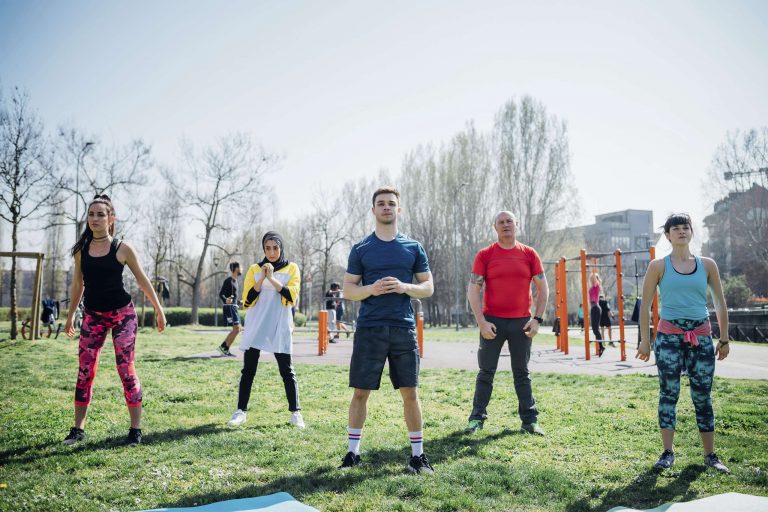
Determine a very short amount of time that you already have available every day (e.g., between waking up and eating breakfast, between coming home from work and doing anything else). Do the minimum amount of practice during that time. When that time is up, stop. Even if you feel like you can do more, stop. You want the routine to be automatic and there is no better way to do that than to stop on time, every time. Within that time, I suggest doing a few simple exercises that work multiple big muscle groups at once. Examples include squats, pushups, planks, etc. They’re good because they don’t require much equipment or setup. You do them during your predetermined time period, and then you are done. That’s it. There is nothing else to do. Repeat daily.
Another big error is to wait for motivation to do the routine. Motivation can fluctuate wildly when you are tired and not focused, and if you rely on it you will not do your routine. The better approach is to think of your routine as a non-negotiable meeting with yourself. Just start with the lowest possible effort, which is to stand up and do 1 slow rep. Once you get moving, the resistance goes away and you will find that doing the routine is much easier than you thought.
If you want to do a quick 15 minute workout for example, start with 4-5 minutes of light activity that gets the blood flowing and loosens up the muscles (basically, light cardio). Then do 4-5 minutes of strengthening movements that you can do while still breathing (that is, not straining and holding your breath). Finally, finish with 4-5 minutes of more relaxed activity like walking, or stretching, which tells your body that the work portion is done. That way, there’s a beginning, middle, and end to the workout. It feels like you’ve completed it, not that it was cut short.
After a while, it starts to feel less like a discipline and you start to see tiny results: a slight ease in movement, a slight improvement in balance, a slight improvement in recovery. You don’t feel like you failed if you miss a day because you can jump back in so easily. This allows you to preserve the habit, and when you do start pushing yourself harder, it will feel more like a natural step up than just more exhausting.